
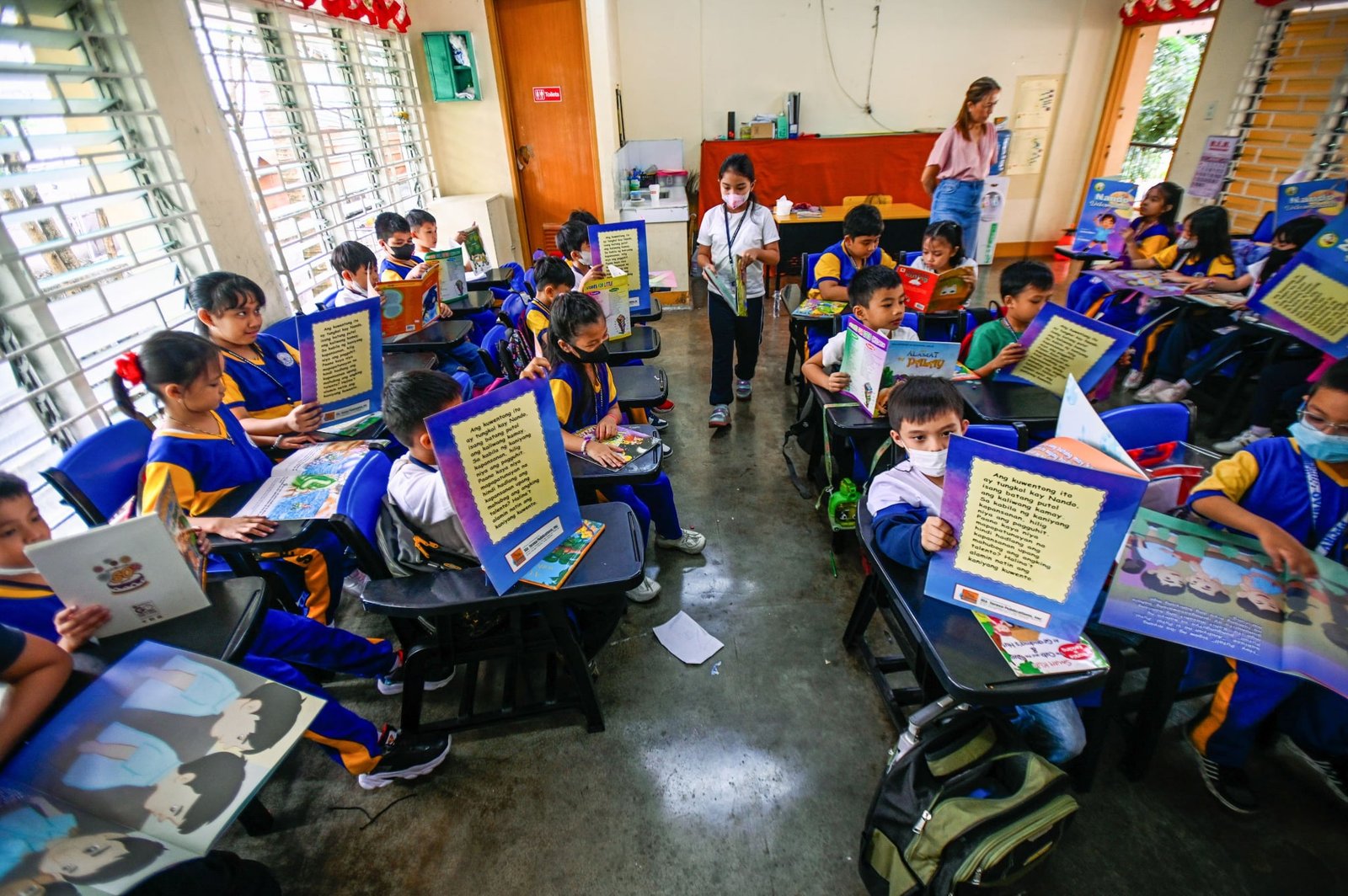


Supervised by their teachers, students of Pinyahan Elementary School initiates their Catch up Fridays’ by reading storybooks.
Twenty points higher in reading, seventeen in science, sixteen in mathematics—but how far can Filipino learners rise when crowded classrooms, outdated books, and persistent bullying continue to stand in their way?
Hope has found its way into Philippine education, carried by numbers that finally point upward. In the latest Programme for International Student Assessment (PISA) results presented in the fact sheet, Filipino students demonstrated improvements across science, mathematics, and reading, signaling that years of educational interventions may be beginning to bear fruit. Yet beneath this encouraging progress lies a deeper concern: rising scores mean little if millions of learners still struggle to receive the education they deserve.
With 373 points in science, 371 in mathematics, and 367 in reading, the Philippines registered gains of 17, 16, and 20 points, respectively, compared with the 2022 assessment cycle. Reading recorded the largest improvement, earning particular recognition for the country’s progress in reading proficiency.
Behind these figures are efforts to strengthen school readiness, expand access to computers and digital learning tools, and create a more supportive testing environment. These initiatives demonstrate that when learners receive adequate preparation and resources, improvement becomes possible.
However, progress must not be mistaken for victory.
Despite the gains, Philippine scores remain below OECD averages of 482 in science, 463 in mathematics, and 461 in reading. The country may be climbing, but the distance between its current performance and international benchmarks reveals how much work remains.
For learners squeezed into overcrowded classrooms, academic success can feel like an uphill battle. For teachers struggling with limited instructional materials and insufficient support personnel, delivering quality education often demands more than dedication alone. Outdated textbooks, inadequate facilities, and concerns over teacher compensation continue to expose weaknesses that higher assessment scores cannot conceal.
Beyond academic difficulties, bullying threatens the very environment where learning should flourish. Students cannot reach their full potential when fear follows them into classrooms, corridors, and school grounds. Education must cultivate not only intelligence but also security, dignity, and belonging.
President Ferdinand Marcos Jr. has acknowledged the country’s improved performance and pledged to sustain education reforms. Turning that commitment into lasting progress, however, requires more than encouraging statements. Schools need additional classrooms, updated learning resources, stronger student welfare programs, and adequate support for the teachers who carry the responsibility of educating the next generation.
More importantly, reforms must reach every learner, including those in underserved communities where access to educational resources remains limited. International assessments can reveal weaknesses and measure improvement, but they cannot independently determine whether every child has a fair opportunity to succeed.
True educational progress begins when a student understands a difficult passage, solves a problem with confidence, or discovers the courage to ask a question. It continues when teachers have the tools to teach effectively and when schools become safe spaces for curiosity rather than sources of fear.
The latest PISA gains offer a reason to celebrate, but they must also serve as a reminder of unfinished work. Sustaining momentum means confronting the structural problems that continue to hold learners back, not simply celebrating the points they have gained.
Because the Philippines will not truly rise in education when its scores climb alone, but when every Filipino learner is given the chance to rise with them.